
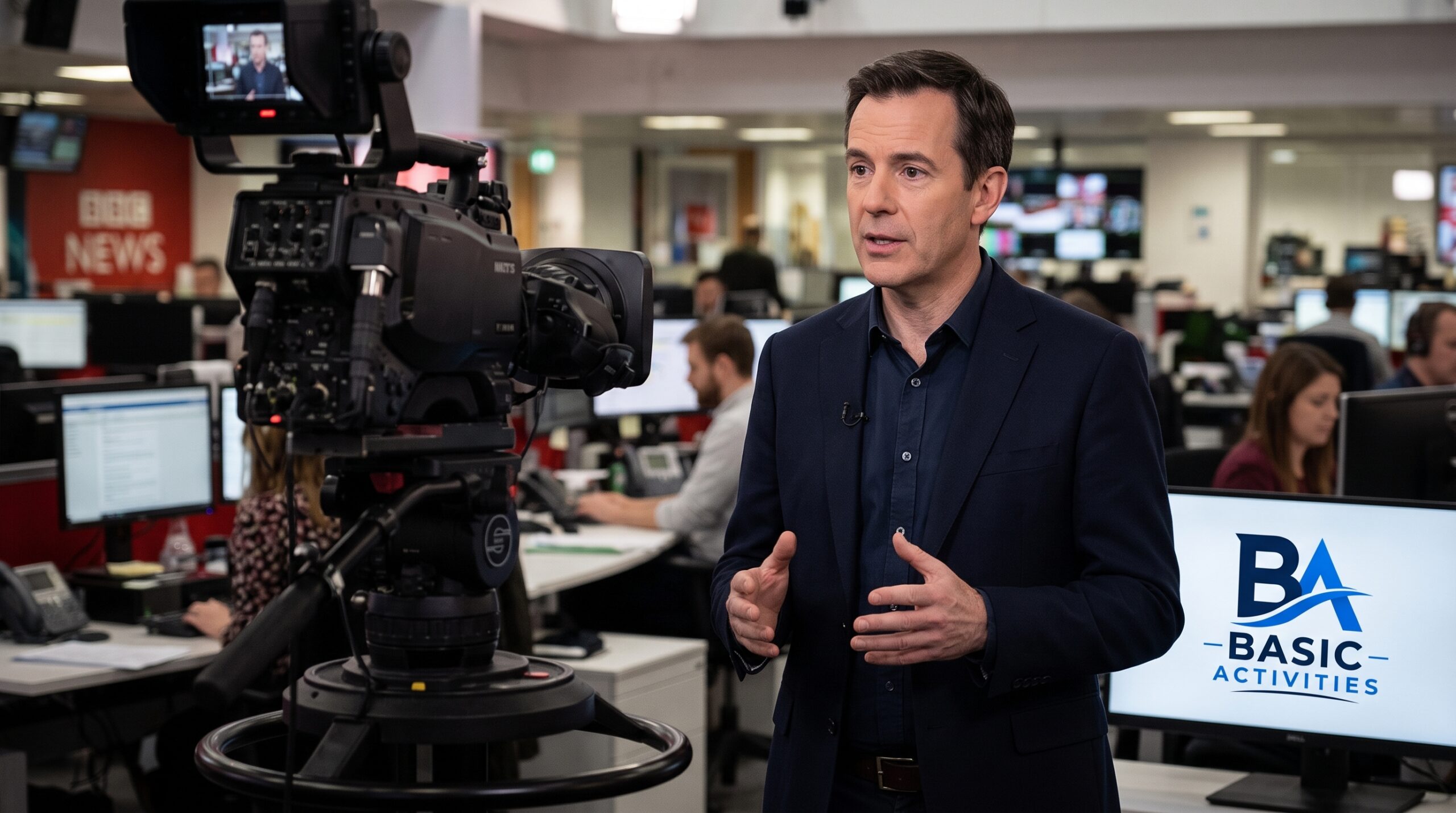
How do you take a tangled, rapidly evolving global crisis and make it completely understandable in under ten minutes? For many, this challenge is the ultimate test of journalism. For BBC Analysis Editor Ros Atkins, it is the defining mission of his career.
Known affectionately as the BBC’s “Explainer-in-Chief” or “The Facts Man,” Ros Atkins has revolutionized modern news presentation. His hyper-focused, heavily researched, and intensely visual video explainers have captured millions of views across the globe. By stripping away standard broadcast theatricality and letting data, chronology, and logic do the heavy lifting, Atkins has pioneered a blueprint for trustworthy, clear, and engaging modern storytelling.
In this article, we delve deep into the journey of Ros Atkins. We will explore his early background, his rapid rise within the BBC, the anatomy of his signature video explainer format, and his broader insights on why the “art of explanation” is more vital today than ever before.
1. Early Life, Education, and the Spark of a Journalist
To understand the methodical nature of Ros Atkins, one must look at his formative years. Born in Cornwall in 1974, Atkins was raised with an innate curiosity about the world. He later went on to study history at Jesus College, Cambridge. It was here, during his undergraduate years, that he first began to obsess over how complex information is structured. Faced with vast reading lists and dense historical texts, he was forced to devise a system to process, condense, and communicate complex narratives rapidly—a skill that would later define his broadcasting.
Before solidifying his place in broadcast news, Atkins traveled and worked across various sectors, including a stint as a DJ, which he has often fondly recalled as influential in learning how to gauge and hold the attention of an audience. He eventually transitioned into full-time journalism, bringing with him a passion for unpacking international stories for diverse crowds.
2. Climbing the Ranks: From BBC Producer to Global Presenter
Ros Atkins’ journey at the BBC was not an overnight success; it was forged through years of hands-on, multi-platform experience. He joined the corporation as a producer for BBC Radio 5 Live, where he learned the fast-paced art of live, reactive broadcasting.
Recognizing his ability to facilitate natural, globally-minded conversations, the BBC transitioned him to presenter roles. He went on to host World Have Your Say on BBC World Service and BBC World News. In 2014, he became the anchor of Outside Source, a cutting-edge, live news program that broke away from traditional, desk-bound news reading. Outside Source actively utilized touchscreens, social media feeds, and on-air news gathering to make audiences feel like they were inside the newsroom itself.
Through these programs, Ros Atkins became a familiar face to international audiences, esteemed for his calm, inquisitive, and highly professional demeanor.
3. Creating “The Explainer”: How Ros Atkins Redefined Digital Journalism
As digital media consumption expanded, broadcast news faced a reckoning: how do you capture the attention of a distracted, online audience without sacrificing journalistic integrity? Atkins and his team responded with a format that changed everything.
Instead of running traditional, reportage-style segments, they began producing digital-first “explainer” videos. This format was characterized by:
- The Chronological “Timeline”: Stripping away fluff to reconstruct exactly what was said or done, step-by-step.
- Juxtaposing Statements: Showing, rather than telling, how political statements or promises changed over time.
- Data and Documentation: Using onscreen graphics, emails, and transcripts as the core evidence.
- A “No-Frills” Delivery: Atkins directly addresses the camera, utilizing conversational, matter-of-fact language without any voice modulation or overly dramatic music.
The result was a viral sensation. Whether unpacking the nuances of Brexit, the pandemic, or geopolitical conflicts, Atkins’ videos proved that the general public was hungry for facts, clarity, and historical context.
4. The BBC 50:50 Project: A Champion for Diversity
Atkins’ impact on modern journalism is not confined to the stories he tells on screen; it also extends to who tells them. In 2017, he pioneered the BBC’s 50:50 Project—a grassroots initiative designed to ensure women and marginalized groups are equally represented in media content.
What started as an informal effort in a single newsroom soon became a global phenomenon. The project uses a simple, self-monitoring system where teams count the diversity of their contributors in real-time to challenge natural biases and promote equal representation. The 50:50 Project has since been adopted by hundreds of teams across the BBC and external media organizations, demonstrating Atkins’ commitment to making journalism reflective of the society it serves.
5. Becoming the BBC’s Analysis Editor
In acknowledgment of his unique impact, the BBC created the role of Analysis Editor for Ros Atkins. This position was designed to capitalize on his ability to provide viewers with high-level context amidst a crowded information landscape.
As Analysis Editor, Atkins is tasked with slicing through the noise to give audiences the raw, verifiable reality of a situation. Rather than merely telling audiences what happened, Atkins provides the why and the how, focusing on factual evidence over sensationalist talking points. In a world increasingly saturated with disinformation, AI-generated content, and highly polarized commentary, his work has been lauded as an essential form of civic education.
6. “The Art of Explanation”: Transforming Insights into a Bestseller
In late 2023, Ros Atkins released his acclaimed book, The Art of Explanation: How to Communicate with Clarity and Impact. In this masterclass of a book, Atkins breaks down the exact system he has used for decades to organize and present ideas.
He argues that regardless of your profession—whether you are a teacher, a corporate executive, or a parent—your success depends on your ability to be understood. Some of his most celebrated tips include:
- The “So What?” Test: If you cannot explain why your information is relevant to the listener, do not include it.
- Drafting and Redrafting: Stripping away extra words to find the absolute core of what you want to say.
- Identifying Your Audience: Designing your communication to fit the natural baseline of the person receiving it, rather than showcasing your own knowledge.
- Structuring Your Narrative: Making sure your points flow in a natural, logical sequence that does not require the listener to work hard to keep up.
The book has become a vital resource for professionals, students, and educators seeking to cut through the noise of daily communication.
7. The Media Show: Navigating the Changing Landscape of Information
In addition to his viral video explainers, Atkins also presents The Media Show on BBC Radio 4. This platform allows him to interrogate the media industry itself. On the show, Atkins discusses the decline of traditional news, the massive rise of social media influencers, the implications of AI, and the ever-shifting trust between the public and the press.
His dual roles as on-air host and investigative media critic offer him a rare, holistic vantage point on modern communication, making him one of the most authoritative voices on the state of 21st-century information.
8. Why Ros Atkins’ Style Resonates in the Age of AI and Information Overload
At its core, the public’s fascination with Ros Atkins highlights a deeper cultural need. Modern internet users are overwhelmed. The speed of social media means we are bombarded with opinions, fragmentations of truth, and hyperbole before we even understand the basic timeline of an event.
Atkins offers a contrast to this chaos. By refusing to engage in sensationalist rhetoric, by validating every piece of data on screen, and by speaking with calm, analytical authority, he satisfies the audience’s natural hunger for objective, digestible truth. He has proved that “dull but factual” is actually incredibly exciting when packaged with precision and visual intelligence.
9. Key Takeaways from Ros Atkins’ Work
For those looking to adopt Atkins’ masterful approach to communication, here are some invaluable takeaways:
| Principle | How to Apply It |
| Brevity | Say what you need to say in as few words as possible. Remove redundancies. |
| Verification | Back up your claims with observable facts, timelines, or reliable documentation. |
| Clarity | Use everyday, natural language. Avoid jargon that can alienate your audience. |
| Empathy | Think about the listener first. What do they need to hear to understand this topic? |
| Structure | Create a natural narrative flow that progresses from point A to point B logically. |
10. Conclusion: The Legacy of a Master Communicator
Through patience, rigorous standards, and an unwavering commitment to clarity, Ros Atkins has secured his spot as one of the most influential broadcasters of the digital era. Whether he is dissecting geopolitical crises on television, advocating for newsroom diversity, or teaching the public how to articulate their own thoughts, Atkins represents the best of public service journalism. He reminds us that in a world crowded with loud opinions, the most powerful thing we can be is clear.
Frequently Asked Questions (FAQs)
What is Ros Atkins’ current role at the BBC?
Ros Atkins serves as the BBC’s Analysis Editor, a role where he focuses on delivering visual, analytical explainers across digital and broadcast platforms. He also hosts The Media Show on BBC Radio 4.
What is “The Art of Explanation” about?
The Art of Explanation is Ros Atkins’ book, published in 2023. It provides a practical, step-by-step guide on how to communicate complex ideas clearly and effectively, using the communication systems he has developed throughout his journalism career.
What is the BBC 50:50 Project?
The 50:50 Project is an initiative founded by Ros Atkins in 2017 to promote equal representation in media. It uses self-monitoring to track and increase the presence of women and marginalized communities within broadcast and digital content.
Why is Ros Atkins called “The Explainer-in-Chief”?
Atkins earned this nickname due to his signature visual “explainer” video format. These videos dissect massive, complicated stories into highly logical, chronological, and objective narratives.
Where can I watch Ros Atkins’ work?
His digital-first explainers are regularly published on BBC News’ website, the BBC News YouTube channel, and his personal social media channels, as well as on BBC World News and BBC One television broadcasts.