The modern media landscape is shifting rapidly, forcing brand builders, digital studios, and specialized firms to rethink how they package, deliver, and charge for their expertise. For decades, the creative industry relied on simple hourly tracking and time-and-materials billing. You tracked your hours, applied a standard markup to cover your overhead, sent an invoice at the end of thirty days, and hoped the client’s internal accounting department paid on time.
However, as client demands evolve and internal marketing teams adopt artificial intelligence to handle repetitive tasks, old billing habits are falling short. Clients no longer want to pay for the raw time it takes an artist, strategist, or designer to complete a deliverable; they want to pay for business results, strategic velocity, and measurable growth.
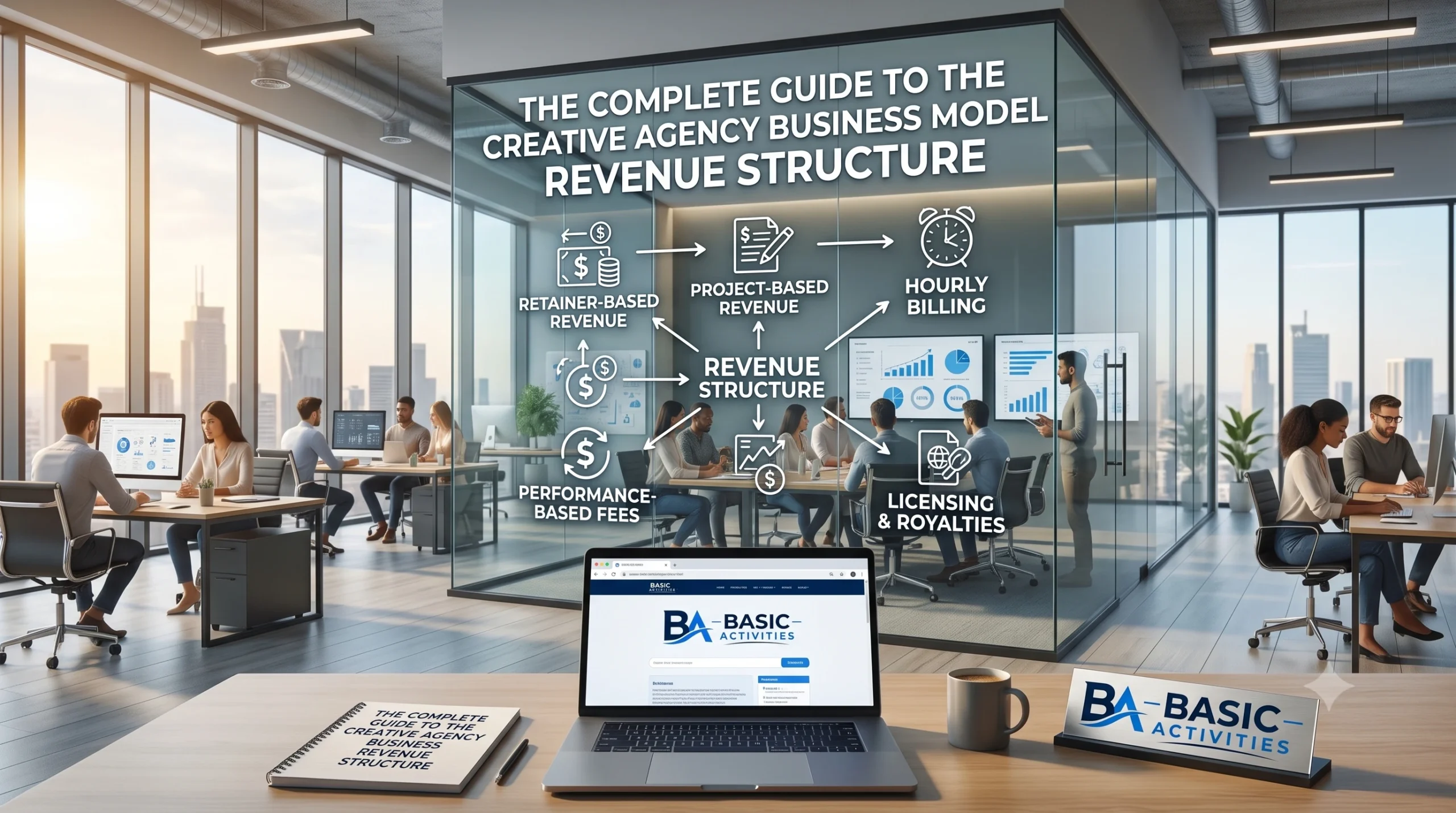
To build a resilient, highly profitable firm today, agency founders and operational leaders must master the creative agency business model revenue structure. Setting up a healthy revenue engine requires aligning client value with financial predictability, protecting profit margins, and scaling operations without overworking your core team.
1. Deconstructing the Foundations of a Creative Agency Business Model
At its core, a business model outlines how an organization creates, delivers, and captures value. In the creative sector, value was traditionally tied directly to human effort—specifically, headcount and billable hours. An agency would hire specialized talent, calculate their hourly cost rate, apply a multiplier (often between 2.5x and 3.5x to cover rent, software licenses, and administrative support), and charge the client based on the total time spent executing a brief.
While this operational framework provided basic cost coverage, it built an inherent conflict of interest directly into the relationship between agencies and their clients. Under a pure time-based system, the slower an agency works, the more money it generates. Conversely, as a team becomes more skilled, efficient, and technologically advanced, its billable hours drop, effectively penalizing the agency for working faster and smarter.
Modern agency design decouples financial compensation from simple inputs. A forward-thinking agency functions as a strategic growth engine for its partners rather than a commoditized service vendor. This transition requires a complete rethink of how service architectures are organized:
- Capabilities vs. Deliverables: Moving away from selling isolated assets (like a single logo file or landing page) toward selling comprehensive solutions (such as market repositioning or end-to-end customer acquisition campaigns).
- Operational Alignment: Structuring creative, technical, and media teams into focused units or cross-functional pods that own client outcomes rather than individual task lists.
- Decoupled Value: Establishing pricing tiers that reflect the strategic impact, market placement, and intellectual property rights handed over to the client, rather than just the production time required.
When an agency shifts its internal culture from tracking hours to managing outcomes, its underlying business engine becomes dramatically more scalable, resilient, and profitable.
2. Core Revenue Streams in the Modern Creative Agency Landscape
A healthy, sustainable creative agency business model revenue structure avoids relying on a single monetization strategy. Relying exclusively on one-off projects leads to unpredictable cash flow, while relying entirely on fixed retainers can leave an agency vulnerable if a flagship client unexpectedly churns. High-performing agencies balance their income by building a diversified revenue mix across distinct service models.
Recurring Monthly Retainers
Monthly retainers form the baseline financial foundation for most established agencies. Under a standard retainer contract, a client pays an agreed-upon recurring fee each month in exchange for guaranteed resource allocation, strategic oversight, and ongoing campaign management. These arrangements give the agency predictable cash flow, making it much easier to forecast payroll, invest in top talent, and commit to long-term software infrastructure. Retainers work especially well for continuous services like performance marketing, search engine optimization, public relations, and ongoing digital content creation.
Project-Based Fixed Pricing
Project-based billing remains the primary entry point for establishing new client relationships. Whether redeveloping a brand identity, launching a custom web platform, or executing a major visual campaign, fixed-fee projects allow clients to commit a specific budget to a well-defined scope of work. For the agency, fixed project pricing presents both opportunities and risks. If the project runs smoothly and internal workflows are streamlined, margins can be exceptionally high. However, poor scope management, frequent revision requests, or unexpected technical hurdles can quickly turn a fixed-fee project into a loss leader.
Value-Based and Performance Pricing
Value-based pricing aligns agency fees directly with the financial upside created for the client. Instead of charging $20,000 to redesign an e-commerce checkout experience based on estimated production hours, an agency might charge $80,000 because the optimization is projected to unlock $1.5 million in new annual gross revenue.
Similarly, performance-based revenue structures tie a portion of the agency’s compensation to specific key performance indicators (KPIs), such as cost-per-acquisition (CPA), qualified leads generated, or total return on ad spend (ROAS). While these models require clear measurement tools and a high tolerance for risk, they offer some of the highest profit margins in the creative industry.
Productized Services and Intellectual Property (IP)
An emerging revenue stream in the creative agency business model revenue structure is the expansion into productized service offerings, proprietary tools, and licensed media assets. By standardizing complex services into fixed-scope, repeatable packages, agencies can sell off-the-shelf solutions with clear timelines and predictable delivery schedules. Additionally, firms that develop specialized design libraries, custom automation scripts, or proprietary strategic frameworks can license these digital assets to clients, unlocking high-margin, passive recurring revenue alongside traditional service delivery.
3. Traditional vs. Emerging Agency Fee Models
Choosing how to price services is one of the most consequential decisions an agency leadership team makes. The decision shapes client expectations, determines operating leverage, and establishes the agency’s competitive positioning in the marketplace. Comparing traditional and modern pricing frameworks highlights how top agencies build sustainable profit margins:
| Pricing Model | Operational Logic | Financial Advantage | Key Operational Risk |
| Time & Materials (Hourly) | Fees are billed per hour worked based on staff cost rates. | Simple to calculate; guarantees basic labor cost coverage. | Limits top-line revenue; rewards inefficiency; invites client micromanagement. |
| Fixed Scope / Project Fee | Set price charged for a defined list of deliverables. | High profit margins on efficient delivery; straightforward client approval. | Vulnerable to scope creep, unplanned revisions, and budget overruns. |
| Monthly Capacity Retainer | Guaranteed monthly access to team bandwidth or credits. | Highly predictable recurring revenue; improved cash flow planning. | Client underutilization or overutilization can strain account relationships. |
| Value-Based Pricing | Pricing is calculated as a percentage of generated client value. | Decouples revenue from billable hours; achieves maximum gross profit margins. | Requires deep market authority, strong sales negotiation, and client trust. |
| Performance-Based Fee | Compensation is directly tied to target KPIs (leads, sales, conversion). | Highly appealing to clients; scales upward with successful campaigns. | Agency assumes external commercial risks (e.g., poor client sales closing, product defects). |
| Hybrid Pricing Engine | Low baseline retainer combined with performance bonuses. | Balances predictable risk coverage with uncapped revenue upside. | Requires clear tracking systems, strict contracts, and precise data attribution. |
4. Operational Cost Structures and Profitability Drivers
Understanding the expense side of the balance sheet is just as critical as bringing in revenue. The cost architecture of a creative agency is typically dominated by human capital, technology infrastructure, and business development expenses. To maintain healthy profit margins, operations leaders must monitor these key expense categories closely:
- Direct Labor Costs (50% – 60% of Revenue): This includes salaries, bonuses, payroll taxes, health benefits, and freelance or contractor expenses. Because creative work relies heavily on human capital, talent is consistently an agency’s largest investment.
- Overhead and Administrative Costs (15% – 20% of Revenue): These cover office leases, operational software, legal and accounting fees, administrative compensation, corporate insurance, and general utilities.
- Technology Stack and Production Tools (5% – 10% of Revenue): Enterprise project management platforms, specialized design applications, cloud infrastructure, AI automation software, and campaign analytics tools form the digital engine of the modern studio.
- Business Development and Marketing (5% – 10% of Revenue): These costs include pitch production, client entertainment, industry conference sponsorships, inbound content marketing, and outbound sales activities needed to keep the pipeline full.
After accounting for direct labor, operational overhead, tech tooling, and sales expenses, a well-managed agency targets an operational net profit margin between 15% and 25%.
Achieving these targets requires tracking key financial metrics. The most critical metric is the Average Billed Rate (ABR), calculated by dividing total collected revenue by the actual hours worked on client projects.
Another essential metric is Utilization Rate, which measures the percentage of paid working hours dedicated to billable client tasks versus internal meetings or administrative work. A healthy agency targets a billable utilization rate of 75% to 85% for production staff and 50% to 65% for strategic leads.
5. Structuring the Hybrid Pricing Engine for Maximum Scale
Transitioning directly from hourly billing to pure value-based pricing can feel risky for both the agency leadership team and conservative clients. This is where the hybrid pricing engine comes in. A hybrid structure combines the financial stability of a baseline monthly fee with the revenue upside of performance incentives or value multipliers.
To implement a successful hybrid pricing engine, structure your commercial proposals into two clear components:
- The Operational Baseline Fee: Charge a monthly retainer that covers the direct labor, software tools, and management overhead required to execute campaign strategies. This covers the agency’s operational costs and establishes a predictable revenue floor.
- The Growth Incentive Layer: Negotiate a performance bonus tied directly to clear, measurable business outcomes. This might be a percentage of net new e-commerce revenue generated above an agreed baseline, a fixed payout for reaching specific lead volume targets, or an equity share in a high-growth startup client.
This blended model protects the agency during slower market conditions while ensuring the creative team shares in the financial gains when a campaign succeeds. It also builds strong trust with clients, proving that the agency has direct skin in the game.
6. Managing Scope Creep and Protecting Profit Margins
Scope creep is one of the biggest threats to profitability within a creative agency business model revenue structure. It occurs when a project’s parameters, deliverable counts, or revision rounds slowly expand without a matching increase in budget or timelines. Left unmanaged, scope creep erodes profit margins, burnt out creative talent, and creates friction in client relationships.
To protect profit margins and keep engagements healthy, agencies need to build clear scope protection mechanisms into their contracts and day-to-day operations:
- Detailed Statements of Work (SOW): Avoid vague project descriptions. Instead of writing “Provide social media management,” clearly define exact numbers: “Deliver 12 original short-form videos, 8 carousel posts, and 2 monthly performance review calls.”
- Explicit Revision Caps: Define exactly what constitutes a standard revision cycle versus a complete scope change. Standard contracts typically include two rounds of minor edits. Additional rounds or major directional shifts should require a formal change order and extra budget.
- Formal Change Order Protocols: Establish a mandatory internal rule: no out-of-scope work begins without a signed change order detailing the additional costs and schedule adjustments. This sets clear boundaries and keeps clients mindful of their requests.
- Real-Time Project Tracking: Use modern project management tools to monitor team velocity and billable hours against budgets in real time. Catching scope expansion early allows account managers to address issues with the client before budgets are exhausted.
Setting clear boundaries early turns potential scope conflicts into professional revenue conversations, ensuring project scope remains aligned with agency profitability.
7. Strategic Retainer Design and Client Lifetime Value (LTV)
While securing new clients is exciting, long-term agency profitability is built on client retention. Acquisition costs for B2B accounts are high, often requiring months of business development, pitch creation, and legal negotiation. Maximizing Client Lifetime Value (LTV) while controlling Customer Acquisition Cost (CAC) is essential for sustainable growth.
Long-term retainer growth relies on continuous value evolution. Retainers often fail when they become transactional line items that clients re-evaluate during budget cuts. To make retainers an essential part of a client’s business, top agencies use key retention strategies:
- Quarterly Growth Audits: Instead of relying solely on routine monthly status updates, host strategic quarterly business reviews (QBRs). Use these sessions to analyze long-term campaign trends, share fresh market insights, and realign creative strategies with the client’s evolving business goals.
- Agile Scope Realignment: Client priorities shift over time. Flexible retainer models allow clients to roll unused capacity into new initiatives—like shifting unused visual design hours into video production—keeping the engagement aligned with current priorities without requiring complex contract renegotiations.
- Proactive Strategic Roadmap Creation: Bring new ideas, campaign concepts, and market opportunities to your clients before they ask for them. Positioning your agency as an proactive strategic partner builds long-term loyalty and dramatically increases lifetime account value.
8. Scaling the Revenue Structure: From Boutique Studio to Enterprise Agency
As a creative agency grows, its underlying revenue model must evolve. The business structure, pricing models, and team workflows that work for a 5-person design boutique will eventually stall a 50-person multi-disciplinary agency. Understanding the distinct growth phases helps agency leaders scale their financial operations smoothly:
Phase 1: The Boutique Craft Studio (1–10 Staff)
In the early stages, agencies typically rely on hourly billing or project-based fixed fees. The founders are usually deeply involved in client work and sales. The primary financial goal at this stage is managing basic cash flow, building a strong portfolio, and establishing a baseline operational cost model.
Phase 2: The Mid-Size Specialized Agency (10–40 Staff)
As headcount increases, overhead costs grow, making fixed monthly retainers essential. At this stage, agencies usually transition from general service offerings to deep industry specialization. The operational focus shifts toward setting up account management teams, standardizing project delivery workflows, and establishing disciplined capacity planning systems.
Phase 3: The Integrated Enterprise Agency (50+ Staff)
At enterprise scale, agencies operate with multi-layered revenue structures that combine performance contracts, value-based pricing, retainer suites, and strategic consulting fees. Leadership focuses on capital allocation, cross-selling services across business units, leveraging automation to improve margins, and expanding into new regional or international markets.
Frequently Asked Questions (FAQs)
What is the most profitable revenue model for a modern creative agency?
Value-based pricing consistently generates the highest profit margins because it decouples agency fees from production hours and direct labor costs. However, many top agencies run a hybrid model—combining a stable recurring retainer floor with outcome-based performance bonuses. This approach pairs reliable cash flow with strong upside profit potential.
How do I transition an existing agency from hourly billing to recurring retainers?
Start by identifying services that clients need continuously, such as performance marketing, content production, search engine optimization, or brand management. Package these services into goal-oriented monthly outcomes rather than hourly task buckets. Position the retainer to clients as a way to secure dedicated team capacity, faster turnarounds, and lower overall costs compared to endless project-by-project statements of work.
What is a healthy target profit margin for a creative agency?
A well-managed creative agency typically targets a net profit margin of 15% to 25% after accounting for all direct labor, operational overhead, software tools, and executive salaries. Gross margins on individual client accounts should ideally stay above 50%.
How can a creative agency prevent scope creep on fixed-price projects?
To prevent scope creep, create detailed Statements of Work (SOWs) that explicitly outline project deliverables, revision limits, and feedback timelines. Establish a mandatory change-order process for any extra client requests, ensuring out-of-scope work is priced and approved before production begins.
Why is relying solely on project-based pricing dangerous for long-term growth?
Project-based pricing creates an unpredictable revenue pattern, often leading to a “feast or famine” financial cycle. When a major project finishes, the agency must quickly secure new pipeline leads to cover fixed overhead costs like salaries and rent. This unpredictability makes long-term hiring, strategic planning, and financial forecasting difficult compared to models built on recurring retainers.