
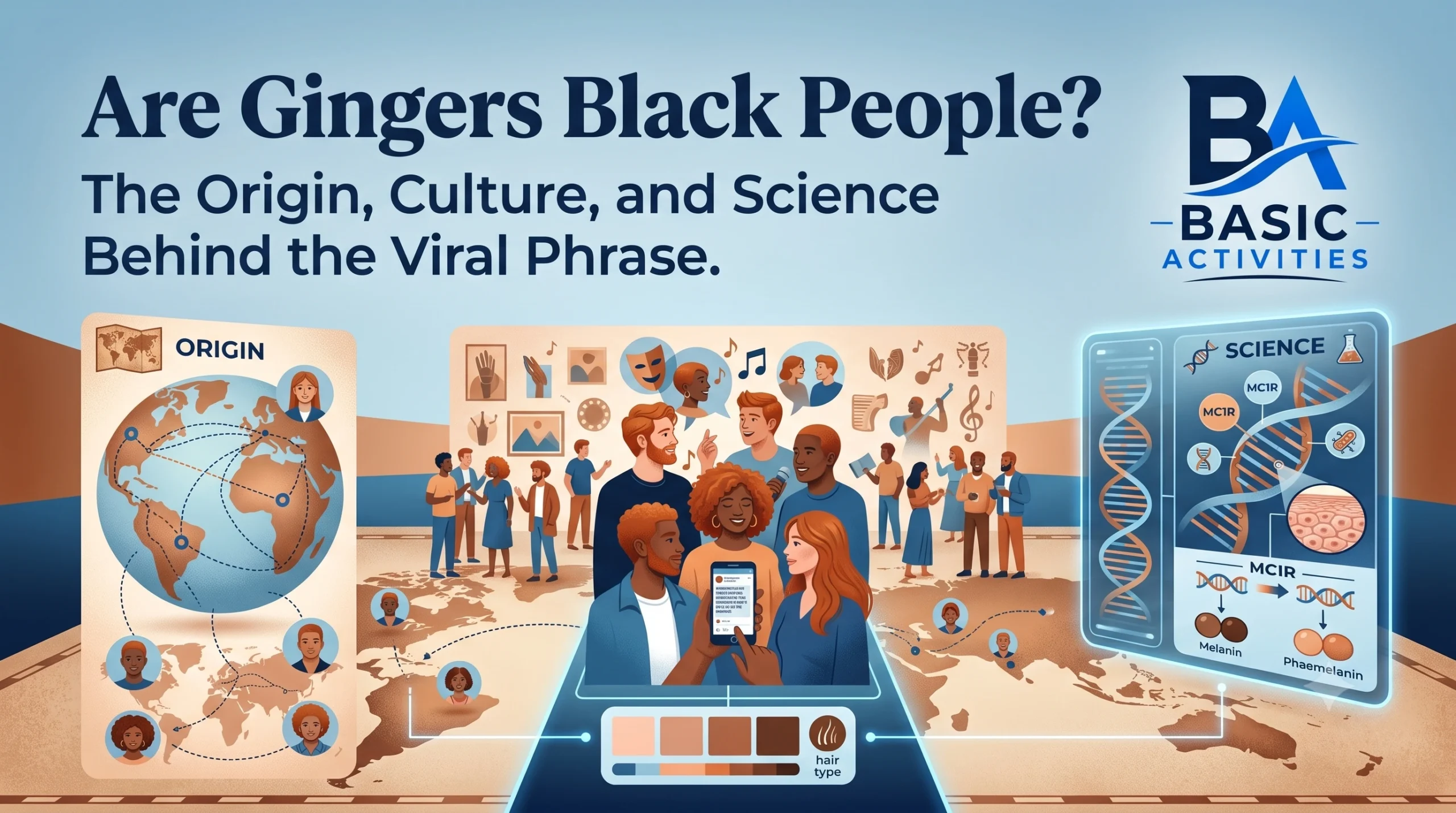
The phrase “Are Gingers Black People?” might sound like a biological impossibility or a confusing cultural oxymoron at first glance. However, if you have spent any time browsing short-form video platforms, social media forums, or online commentary spaces recently, you have likely encountered this exact sentence. What started as a viral internet phrase quickly exploded into a global conversation spanning genetic science, pop culture history, social dynamics, and the shared psychological human experience of being “othered” within a society.
To understand why people are asking this question, one must look at both the literal and metaphorical layers behind the claim. Literally, red hair—often casually termed “ginger”—is a physical trait driven by specific genetic mutations that exist across all global racial groups, including people of Black African descent. Culturally and metaphorically, the phrase emerged from a viral social media trend where Black creators and white redheads began discussing historical marginalization, societal teasing, and the feeling of existing on the outer fringes of dominant racial or social standards.
This article explores the entire landscape behind the topic. We will dive deep into the origin of the viral phrase, unpack the real genetics of red hair across diverse populations, analyze the historical social treatment of redheads, examine the historical solidarity between specific ethnic groups, and evaluate why this unusual topic captured the internet’s fascination.
The Social Media Origin: Decoding the Viral Trend
The rapid rise of the phrase “gingers are Black people” or “gingers are the Black people of the white community” can be traced directly to digital culture. Social media algorithms excel at taking bold, provocative claims and amplifying them into widespread cultural discussions. The trend originally sparked when creators on platforms like TikTok and Instagram posted commentary suggesting that individuals with red hair experience a unique form of social treatment that sets them apart from the broader, dominant white demographic.
What began as a tongue-in-cheek comment quickly evolved into an unexpected space for storytelling and emotional connection. Red-headed creators began sharing personal accounts of growing up with intense bullying, unwanted public touching, exclusion, and derogatory nicknames. In response, many Black creators offered empathy and validation, drawing parallels between the shared emotional burden of being visually distinct in spaces that value conformity.
The phrase was never intended to be a literal reassignment of racial identity. Instead, it functioned as a conversational catalyst—a piece of hyperbole designed to highlight how dominant social groups often create a secondary “out-group” even within their own racial demographics. While critics pointed out that comparing teasing over hair color to systemic racial discrimination can flatten important historical contexts, the dialogue nevertheless fostered an unusual bridge of empathy between disparate communities.
The Genetics of Red Hair: How “Ginger” Traits Actually Work
From a strictly biological standpoint, hair color is determined by the types and amounts of melanin produced by specialized cells called melanocytes. Red hair, fair skin, and freckles are primarily caused by variations in the Melanocortin 1 Receptor ($MC1R$) gene. When a person carries two altered copies of the $MC1R$ gene (one inherited from each parent), their body produces significantly higher amounts of pheomelanin (red and yellow pigments) rather than eumelanin (dark brown and black pigments).
Because the $MC1R$ gene trait is recessive, both parents must carry the genetic variant for a child to express bright red hair. While this recessive trait is most statistically prevalent in populations of Northwestern European ancestry—particularly in places like Scotland, Ireland, and Wales—the genetic code for red hair is not limited to any single geographic region or racial group.
Because human genetics are ancient and interconnected, $MC1R$ variations can appear spontaneously or persist silently across generations in diverse global lineages. Consequently, the biological trait for red hair exists independently of racial classifications, serving as a reminder that phenotype (visible physical traits) does not always fit neatly into fixed racial categories.
Can Black People Biologically Have Natural Red Hair?
The short answer is yes: Black people can naturally have red hair. While red hair in individuals of African descent is relatively rare compared to dark brown or black hair, it occurs naturally through several distinct biological and genetic mechanisms.
| Biological Mechanism | Cause & Description | Primary Expression |
| Recessive $MC1R$ Trait | Both parents pass on a recessive copy of the $MC1R$ gene variant through inherited lineage. | Natural auburn to vivid red hair with dark or brown skin tone. |
| Rufous Albinism (Type 3) | A specific form of oculocutaneous albinism caused by mutations in the $TYRP1$ gene. | Reddish-brown hair, reddish skin tone, and hazel or brown eyes. |
| Admixture & Inheritance | Multi-generational racial mixture where recessive European traits surface down the line. | Varied shades of red, copper, or ginger curly/coily hair textures. |
| Nutritional Shifts (Non-Genetic) | Temporary color shifts due to conditions like Kwashiorkor (severe protein deficiency). | Faded, rust-red, or yellowish hair color that reverts with proper nutrition. |
In addition to genetic variations like Rufous Albinism (Oculocutaneous Albinism Type 3), which specifically produces reddish skin and deep red hair in African and New Guinean populations, many Black individuals carry red-hair genes inherited through historic family admixture. Photographers and anthropologists have documented naturally red-haired Black individuals across Africa, the Caribbean, North America, and South America, proving that the “ginger” hair trait is a global human phenomenon rather than an exclusively European one.
Historical Context: The Treatment of Redheads in Western History
To fully grasp why redheads are sometimes framed as an “othered” group within majority-white societies, one must look at Western history. Red hair has spent centuries oscillating between fascination, superstition, and overt hostility in European culture.
During the Middle Ages and the Early Modern period, red hair was frequently associated with negative moral characteristics, unpredictable temperaments, or unnatural origins. In medieval European art, villainous or treacherous figures—including Judas Iscariot—were routinely depicted with bright red hair to signal untrustworthiness to illiterate audiences. During the Spanish Inquisition, red hair was used by persecutors as a physical marker to identify and target Jewish populations.
In more recent British and Commonwealth history, the term “ginger” was frequently used as a derogatory label. Schoolchildren and adults alike faced persistent anti-ginger bias, ranging from social exclusion and physical harassment to casual workplace discrimination. Unlike traits that blend seamlessly into majority populations, bright red hair stands out visually instantly, making those who possess it easy targets for group-based teasing or marginalization.
Irish History and the Colonial Dynamic of “Whiteness”
A major subtext underlying the “gingers are Black” discussion is the historical treatment of the Irish people, who possess the highest concentration of the red-hair gene globally. Understanding how the Irish were historically treated provides crucial context for why these cultural parallels are drawn.
For centuries, the British Empire subjected Ireland to colonial conquest, land confiscation, systemic disenfranchisements, and cultural suppression. Victorian-era cartoonists and phrenologists routinely depicted Irish people with exaggerated, ape-like features, using pseudo-scientific racial theories to justify their subjugation. When millions of Irish refugees fled to North America during the Great Famine of the 1840s, they were met with extreme anti-Catholic and anti-Irish hostility, often forced into the lowest socioeconomic tiers alongside free Black Americans.
Historical Insight: Historians like Noel Ignatiev have documented that “whiteness” in Western society was not always an all-inclusive racial boundary. Groups like the Irish had to undergo a lengthy social transformation to be accepted into the dominant white majority, often facing severe discrimination prior to that assimilation.
Because red hair was strongly associated with Irish identity, anti-ginger sentiment historically overlapped with anti-Irish prejudice. In early American cities, Irish laborers and Black laborers lived in the same neighborhoods, worked the same dangerous jobs, intermarried, and formed early labor alliances. This historic intersection created a genuine cultural overlap that modern internet commentary periodically rediscover.
Sociological Analysis: The “Out-Group” Effect and Visible Difference
Why do human societies constantly target specific physical traits for discrimination or humor? Sociologists explain this phenomenon through Social Identity Theory and the concept of the in-group versus out-group dynamic.
Human communities naturally gravitate toward social cohesion through shared, familiar traits. When an individual displays a rare physical marker—whether it is dark skin in a majority-white country, light skin in a dark-skinned region, or bright red hair in a room of brunettes—the dominant majority immediately registers that individual as “different.”
- Hyper-Visibility: People with distinct physical traits cannot easily fade into a crowd, making their actions more scrutinized by peers.
- Stereotyping & Caricature: Unique traits are often reduced to singular personality tropes (e.g., the belief that redheads have “fiery tempers”).
- Boundary Maintenance: Dominant social groups use jokes, nicknames, or exclusion to enforce social hierarchies and reward normative appearances.
While the severity and systemic weight of racial discrimination far outstrips the social discomfort of having red hair, the psychological mechanisms behind the bullying are rooted in the same human impulse: penalizing individuals for standing out visually from the collective norm.
Comparing Social Persecution vs. Systemic Oppression
To maintain clarity and fairness, it is crucial to draw a clear distinction between social prejudice and systemic oppression. This distinction lies at the heart of why some cultural commentators caution against taking internet comparisons too literally.
A person with red hair in the modern Western world may face childhood bullying, awkward social interactions, or unfair stereotypes. However, they do not face legal disenfranchisement, housing discrimination (redlining), systemic police profiling, or generational wealth disparities based on their hair color. Once a white person with red hair steps into a professional setting or interacts with institutions, their racial privilege as a white individual remains intact.
Conversely, anti-Black racism operates on both individual and structural levels, shaping access to capital, justice, healthcare, and safety across generations. Recognizing this difference allows people to appreciate the empathy expressed in online trends without erasing the serious reality of systemic racial injustice.
Red Hair Across Global Cultures and Ethnicities
Outside of the Western sphere, red hair carries vastly different cultural meanings, demonstrating how physical traits are interpreted through different regional lenses.
1. Central and East Asia
In regions of Central Asia, red and light-colored hair can be found among populations in Tajikistan, Afghanistan, and northern China, often tracing back to ancient Indo-European lineages, Tarim basin mummies, or historic ethnic groups like the Udmurt people of Russia. In East Asia, red hair occasionally appears in isolated rural populations, where it is treated with a mix of local curiosity and ancestral folklore.
2. Polynesia and the Pacific Islands
In Polynesian traditional culture, individuals born with reddish-brown hair (known in some regions as ehu) were historically viewed with high reverence. Red hair was frequently interpreted as a mark of direct descent from noble ancestors or gods, conferring social prestige rather than stigma.
3. North Africa and the Middle East
Red hair occurs naturally among Berber populations in Morocco (particularly the Riffian people) and Algeria (the Kabyle people), as well as among various Middle Eastern communities. In these regions, the trait is integrated into local ethnic diversity and carries no special social stigma.
Conclusion: What the Trend Teaches Us About Human Connection
The viral conversation surrounding the phrase “Are Gingers Black People?” is ultimately less about reclassifying biological race and more about human empathy in a digital age. It reflects how social media allows diverse groups of people to find unexpected common ground through shared personal stories of feeling different, misunderstood, or visually sidelined.
Biologically, red hair is a universal human trait powered by genetic variations that exist across all racial backgrounds, including Black communities around the globe. Culturally, the dialogue surrounding redheads highlights how social norms can create out-groups in any setting. By recognizing the boundary between lighthearted empathy and real systemic history, society can appreciate these moments of online solidarity as a reminder that the human desire for acceptance and belonging transcends physical traits.
Frequently Asked Questions (FAQs)
1. Are gingers biologically considered Black people?
No. “Ginger” refers to a physical trait (red hair, fair skin, freckles) caused primarily by variations in the $MC1R$ gene, whereas “Black” refers to racial and ethnic ancestry tied to African lineage. While Black people can have natural red hair, having red hair does not make a white person racially Black.
2. Why did the phrase “gingers are Black” go viral on TikTok?
The phrase went viral after Black social media creators used hyperbole to point out how white redheads are often teased, bullied, or “othered” within majority-white communities. Redheads responded by sharing their experiences, creating an unexpected trend centered on empathy and shared feelings of social exclusion.
3. Can a person of 100% African descent have natural red hair?
Yes. Natural red hair in Black individuals can occur due to specific genetic mutations such as Rufous Albinism (Type 3 albinism), rare recessive $MC1R$ gene expressions, or historical genetic admixture.
4. What gene is responsible for red hair?
Red hair is primarily caused by recessive variants of the Melanocortin 1 Receptor ($MC1R$) gene located on chromosome 16. When inherited from both parents, it causes the body to produce high levels of red/yellow pheomelanin instead of dark eumelanin.
5. Were Irish people historically treated like racial minorities?
During the 18th and 19th centuries, Irish immigrants in Britain and North America faced severe discrimination, anti-Catholic prejudice, and socioeconomic marginalization. While they eventually assimilated into mainstream white society, their historic subjugation created significant intersections with Black history.
6. Is “ginger” considered a derogatory word?
In some countries, particularly the United Kingdom, Australia, and Ireland, “ginger” has historically been used in a derogatory or mocking manner. While many red-haired individuals reclaim the term proudly today, it can still carry negative connotations depending on tone and context.