
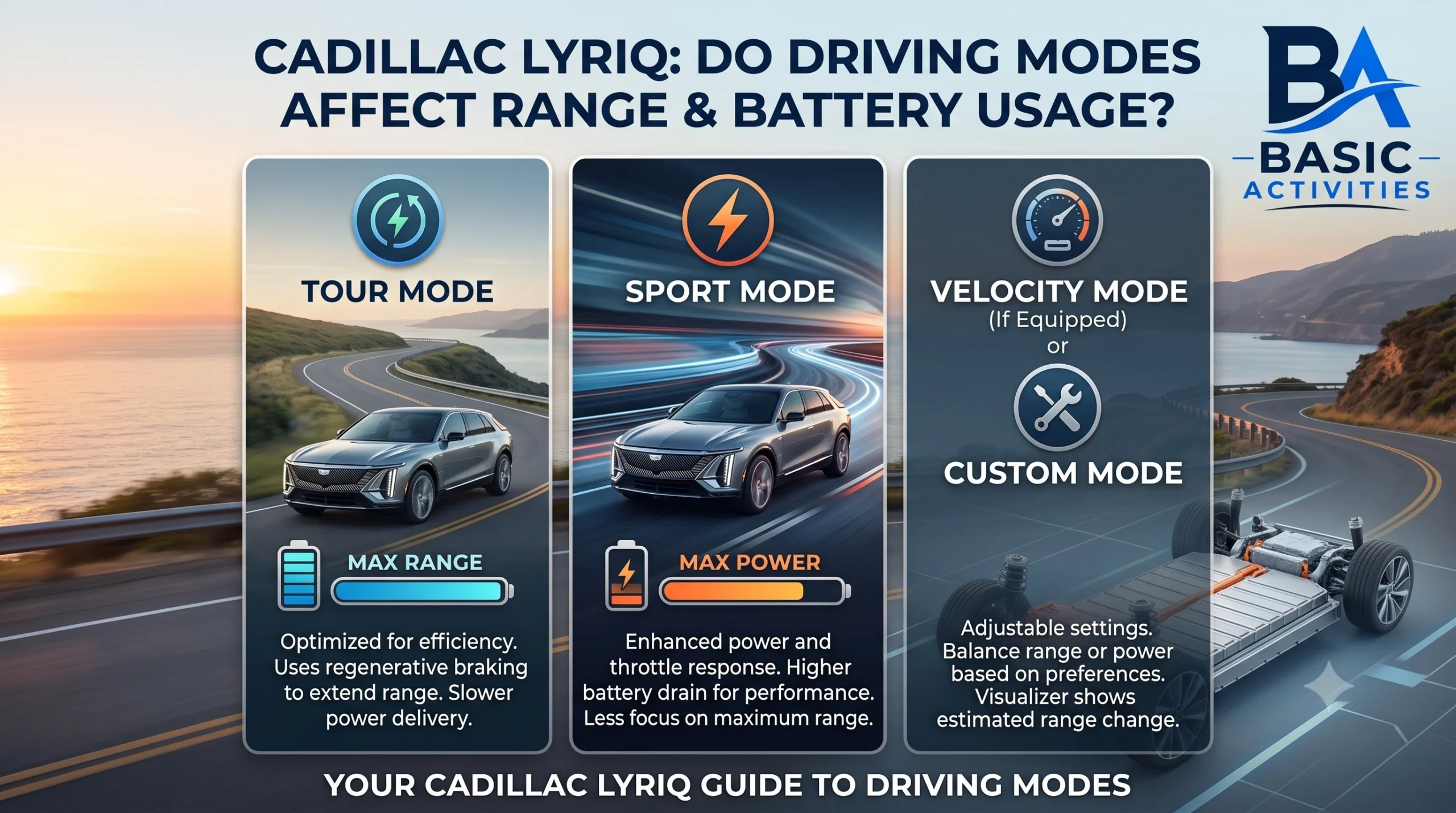
The Cadillac Lyriq has established itself as a flagship luxury electric crossover, combining General Motors’ Ultium EV platform with refined interior luxury, sharp styling, and impressive performance. However, as with any advanced electric vehicle, maximizing driving range and managing high-voltage battery consumption are top priorities for owners. A common query among prospective buyers and current owners revolves around the vehicle’s selectable drive profiles: do the driving modes in cadillac lyriq offer different ranges or battery usages?
The short answer is yes. Selecting different drive modes in the Cadillac Lyriq fundamentally changes throttle mapping, motor engagement, steering feel, chassis dynamics, and energy recovery aggressiveness. These adjustments directly influence how rapidly energy is drawn from the 102 kWh Ultium battery pack, altering real-world driving efficiency and total usable range. Understanding how these modes function—and how they impact energy efficiency—allows drivers to tailor their experience based on whether they need maximum range or maximum responsiveness.
Understanding the Core Architecture of Cadillac Lyriq Drive Modes
To grasp how driving settings influence electric consumption, it helps to look at the underlying engineering of the vehicle. The Cadillac Lyriq offers several distinct drive modes—typically accessible via the central infotainment screen or physical center console control. These modes include Tour Mode, Sport Mode, Snow/Ice Mode, and a customizable My Mode. Select performance models or software-upgraded dual-motor variants also feature additional modes such as Velocity Max.
Each mode adjusts key powertrain parameters:
- Throttle Mapping (Tip-In Sensitivity): How aggressively the electric motors respond to accelerator pedal input.
- Motor Activation & Torque Distribution: On All-Wheel Drive (AWD) models, modes control when the front motor engages versus when the vehicle relies primarily on the rear motor for cruising.
- Brake Feeling & Regenerative Resistance: Adjusts the deceleration force during pedal lift-off and foot-brake application.
- Steering & Suspension Response: Modulates electronic power steering effort and damper stiffness on equipped models.
Because electric motors deliver instant torque, aggressive pedal mapping translates directly into immediate, high-amperage battery discharge. Therefore, even if two driving modes share the exact same top speed capabilities, the manner in which power is requested and delivered alters overall energy expenditure.
Do the Driving Modes in Cadillac Lyriq Offer Different Ranges or Battery Usages?
When evaluating whether do the driving modes in cadillac lyriq offer different ranges or battery usages, it is essential to distinguish between theoretical software limits and physical energy consumption. The Cadillac Lyriq’s drive modes do not artificially restrict the total battery capacity; you always have access to the full usable energy stored in the Ultium pack. However, the drive modes significantly alter the rate at which that energy is consumed per mile driven.
In laboratory conditions (such as the EPA test cycle), range is calculated using a standardized driving pattern. In real-world conditions, however, changing modes leads to distinct variations in kilowatt-hour per mile ($\text{kWh/mi}$) or miles per kilowatt-hour ($\text{mi/kWh}$) efficiency.
| Drive Mode | Primary Focus | Throttle Response | Typical Efficiency (mi/kWh) | Estimated Real-World Range Impact |
| Tour Mode | Daily Efficiency & Comfort | Smooth / Linear | $2.8 – 3.4 \text{ mi/kWh}$ | Baseline EPA Estimate (~307–314 mi) |
| Sport Mode | Dynamic Performance | Sharpened / Immediate | $2.2 – 2.7 \text{ mi/kWh}$ | $10\% – 20\%$ Reduction |
| Snow/Ice Mode | Low-Traction Safety | Subdued / Gradual | $2.5 – 2.9 \text{ mi/kWh}$ | $5\% – 15\%$ Reduction (often cold weather linked) |
| My Mode | Personalized Setup | User Configurable | Varies by Configuration | Matches Tour or Sport settings |
Drivers who ask do the driving modes in cadillac lyriq offer different ranges or battery usages will quickly observe that switching from Tour to Sport during aggressive highway or city driving reduces overall efficiency by roughly 0.3 to 0.7 $\text{mi/kWh}$. Over a full charge cycle, that efficiency shift can equal a variance of 30 to 60 miles of total driving range.
Tour Mode: Maximizing Efficiency and Preserving Battery Life
Tour Mode is the default operational state for the Cadillac Lyriq. Engineered to strike a balance between luxury, effortless acceleration, and maximum energy conservation, Tour Mode recalibrates the vehicle’s powertrain for smooth, continuous power delivery.
In Tour Mode, the pedal curve is tuned with a gradual “tip-in” profile. When you press the accelerator, power ramps up predictably rather than delivering a sudden torque spike. This smooth acceleration prevents massive current draws from the battery, reducing internal heat generation within the Ultium cells and keeping energy dissipation to a minimum.
On Dual-Motor AWD variants of the Lyriq, Tour Mode prioritizes single-motor propulsion during steady-state highway cruising. The front electric motor disengages or operates with minimal power draw when high-traction demands are low. By avoiding unnecessary dual-motor energization, Tour Mode reduces parasitic electrical losses, allowing the Lyriq to achieve its highest efficiency metrics, often reaching between 3.0 and 3.4 $\text{mi/kWh}$ in temperate conditions.
For long-distance road trips, interstate travel, or routine daily commutes, Tour Mode is the optimal setting to achieve or exceed the EPA-estimated 307-mile (AWD) or 314-mile (RWD) range limits.
Sport Mode: Performance Demands vs. Battery Consumption Rates
Sport Mode completely transforms the personality of the Cadillac Lyriq, sharpening pedal responsiveness, stiffening steering feel, and modifying active brake feedback. However, this heightened dynamic performance comes at the direct expense of battery efficiency.
When Sport Mode is engaged, the accelerator mapping becomes extremely sensitive. Even small movements of the gas pedal request instantaneous, high-level kilowatt output from the Ultium drive units. On AWD models, both front and rear permanent magnet/induction motors remain continuously energized to provide immediate, torque-vectoring response off the line.
So, do the driving modes in cadillac lyriq offer different ranges or battery usages when switching into Sport Mode? Absolutely. The increased energy usage stems from two main factors:
- High Peak Amperage Draw: Rapid acceleration draws large bursts of energy from the battery pack. High current draw increases thermal buildup, which in turn prompts the Lyriq’s battery thermal management system to expend additional energy running coolant pumps and chiller compressors to keep the battery within safe temperature thresholds.
- Driver Behavior Shifts: Because Sport Mode makes the vehicle feel significantly lighter and faster, drivers naturally accelerate more aggressively. Frequent, rapid accelerations and hard decelerations drain battery charge far faster than steady-rate cruising.
In real-world testing, continuous driving in Sport Mode generally results in efficiency ratings dropping down to $2.2 – 2.6 \text{ mi/kWh}$. If sustained over an entire discharge cycle, total range can drop from over 300 miles down to 220–250 miles.
Snow/Ice Mode: Managing Traction and Power Distribution in Cold Climates
Snow/Ice Mode is engineered specifically to prevent wheel slip on low-friction surfaces like icy highways, slushy roads, or wet gravel. Rather than maximizing acceleration or sportiness, this mode intentionally softens pedal responsiveness and limits sudden torque delivery.
In terms of pure electrical output, Snow/Ice Mode restricts sudden power spikes, which theoretically aids efficiency. However, the real-world battery usage associated with Snow/Ice Mode is heavily influenced by environmental conditions. When driving in conditions that warrant Snow/Ice Mode, ambient temperatures are typically near or below freezing.
Cold weather impacts battery usage through multiple avenues:
- Cabin HVAC Load: Heating the Lyriq’s interior using the heat pump and resistive cabin heaters requires substantial electrical power, drawing anywhere from 2 kW to 6 kW continuously.
- Battery Preconditioning & Thermal Maintenance: Lithium-ion battery chemistry slows down in cold weather. The Lyriq automatically routes battery power to internal heaters to keep the Ultium cells within an optimal operating temperature window.
- Traction Control Interventions: In Snow/Ice Mode, the vehicle’s electronic stability control and traction management systems frequently adjust individual wheel torque to maintain directional stability, slightly increasing energy overhead.
Therefore, while the drive mode itself is designed for smooth, metered power usage, driving in cold conditions will result in lower overall range—often $1.8 – 2.5 \text{ mi/kWh}$—primarily due to low ambient temperatures and high thermal management loads rather than the software mode alone.
My Mode & Velocity Max: Customizing Driving Parameters for Range Balance
To give drivers finer control over their vehicle’s behavior, Cadillac included My Mode. This customizable setting allows owners to mix and match individual operational parameters. For instance, a driver can pair Tour acceleration with Sport steering and Sport brake feel.
This raises another critical point regarding do the driving modes in cadillac lyriq offer different ranges or battery usages: My Mode provides an ideal workaround for drivers who want a sporty feel without sacrificing battery range. By setting acceleration response to “Tour” (or “Relaxed”) while setting brake feel and steering to “Sport,” drivers enjoy a firmer, more engaging chassis control while maintaining smooth, energy-efficient battery output.
Velocity Max (Model/Software Specific)
On higher-performance configurations or dual-motor models equipped with GM’s performance software unlocks, Velocity Max unlocks maximum system power, pushing the Lyriq AWD to 500+ horsepower and max torque.
Engaging Velocity Max primes the Ultium battery pack by lowering its operating temperature target using active liquid cooling to prepare for extreme power discharge. This cooling preparation, combined with the extreme current draw during full-throttle launches, consumes battery power at a significantly higher rate than standard driving modes. Utilizing Velocity Max repeatedly will noticeably lower your estimated range display on the digital instrument cluster.
How One-Pedal Driving and Regenerative Braking Impact Mode-Based Efficiency
A critical element tied into the Cadillac Lyriq’s efficiency and drive mode structure is regenerative braking. Regenerative braking captures kinetic energy during deceleration and converts it back into chemical energy stored in the high-voltage battery.
The Cadillac Lyriq offers two main methods of energy recovery:
- One-Pedal Driving: Selectable via the infotainment display, this system allows drivers to accelerate, decelerate, and bring the vehicle to a complete stop using only the accelerator pedal. It provides selectable settings: Off, Normal, and High.
- Regen on Demand Paddle: Located behind the left side of the steering wheel, this pressure-sensitive paddle allows drivers to manually apply smooth, variable regenerative braking force on demand.
Regardless of whether you are driving in Tour Mode, Sport Mode, or My Mode, enabling One-Pedal Driving in ‘High’ setting significantly boosts energy recovery in stop-and-go city traffic. In urban driving environments, heavy regenerative braking can recapture up to $20\% – 30\%$ of the energy expended during acceleration, drastically offsetting the higher energy usage seen in modes like Sport.
Conversely, on flat, open highway stretches, coasting with low regenerative drag (or utilizing Adaptive Cruise Control / Super Cruise) can sometimes prove more efficient than aggressive One-Pedal deceleration, as maintaining momentum requires less energy input than constantly re-accelerating after unwanted pedal-lift slowdowns.
Real-World Testing: Efficiency Differences Between RWD and AWD Lyriq Variants
To fully address how driving modes affect energy usage, we must consider the mechanical differences between the Rear-Wheel Drive (RWD) and All-Wheel Drive (AWD) Cadillac Lyriq models.
- Cadillac Lyriq RWD: Features a single permanent magnet electric motor mounted on the rear axle, outputting approximately 340 horsepower.
- Cadillac Lyriq AWD: Features a dual-motor configuration (front and rear motors), outputting 500 horsepower and 450 lb-ft of torque.
Because the RWD model carries less curb weight and operates with a single motor, its drive mode variations produce slightly smaller overall swings in battery consumption. Switching to Sport Mode in an RWD Lyriq sharpens throttle response, but it does not engage an additional physical motor.
In contrast, the AWD Lyriq experiences a more noticeable shift in efficiency across modes. In Tour Mode, front-motor disconnect technology allows the AWD Lyriq to approximate single-motor efficiency during constant-speed highway driving. In Sport Mode, the front motor remains continuously energized and torque-ready, introducing extra electrical parasitic drag and increasing overall battery consumption even during steady cruising.
Practical Energy Management Tips to Optimize Cadillac Lyriq Battery Range
If you want to enjoy the responsiveness of your Cadillac Lyriq while maintaining maximum battery life and range, consider implementing these practical driving techniques:
1. Utilize “My Mode” for Custom Balance
Set your throttle map to “Tour” or “Relaxed” for efficient power delivery, but dial steering and braking up to “Sport” for an engaging, tight driving feel without incurring battery energy penalties.
2. Precondition While Plugged In
Before departing on long trips, use the myCadillac app or vehicle schedule to precondition the cabin and battery while connected to a Level 2 or DC Fast Charger. Preconditioning uses grid power rather than stored battery energy to warm or cool the Ultium pack and cabin, preserving your initial state of charge.
3. Leverage One-Pedal Driving in City Traffic
Enable One-Pedal Driving when navigating city streets, stop-and-go commutes, or mountainous downhills. This maximizes kinetic energy recovery through the regenerative braking system.
4. Manage Highway Speeds
Aerodynamic drag increases exponentially with speed. Cruising at 68–72 mph in Tour Mode yields significantly better $\text{mi/kWh}$ efficiency than cruising at 78–80 mph, regardless of which drive mode is active.
5. Smart Climate Control Use
Rely on heated/ventilated seats and heated steering wheel functions rather than cranking the main cabin HVAC air temperature to maximum. Direct surface heating uses a fraction of the electricity required to heat the entire cabin air volume.
Frequently Asked Questions (FAQs)
Does driving in Sport Mode damage the Cadillac Lyriq battery?
No. Sport Mode is fully tested and backed by General Motors’ battery management software. It increases energy consumption and current draw, which reduces overall range for that charge cycle, but built-in thermal management systems protect the Ultium battery from overheating or premature degradation.
Why does my estimated range decrease immediately when I switch from Tour to Sport Mode?
The Cadillac Lyriq uses a dynamic range estimation algorithm (often called a “Guess-o-Meter”). This system continuously calculates remaining range based on recent driving habits, climate usage, and selected drive mode. When you select Sport Mode, the computer adjusts its projection downward to reflect the higher expected power consumption of that profile.
Does Snow/Ice Mode save more battery than Tour Mode?
Not necessarily. While Snow/Ice Mode dampens accelerator sensitivity, it is typically used in cold weather where cabin heating, battery thermal management, and reduced chemical efficiency drain the battery faster. In warm weather on dry pavement, Tour Mode remains the most energy-efficient choice.
How much range do you lose in Sport Mode compared to Tour Mode?
On average, drivers observe a $10\%$ to $20\%$ reduction in overall efficiency when driving continuously in Sport Mode compared to Tour Mode. On a full 100% charge, this equates to a difference of approximately 30 to 60 miles of total range, depending on speed, terrain, and acceleration habits.
Does One-Pedal Driving work in all drive modes?
Yes, One-Pedal Driving can be engaged across Tour Mode, Sport Mode, Snow/Ice Mode, and My Mode. You can easily turn it on or off or adjust its sensitivity through the vehicle settings menu on the curved 33-inch LED display regardless of your active drive mode.